

By Tibi · Founder & Editor, Travel Trove Tips
You can enjoy Sibiu without a car.
For the historic centre, walking will do much of the work. Local buses can extend that reach to places such as the ASTRA Museum and Păltiniș.
Day trips are where the answer becomes more complicated.
Some destinations work surprisingly well without driving. Others have a train or bus on paper but become awkward once you add the final walk, attraction opening hours, limited return services or one connection you cannot afford to miss.
So this guide does not ask only:
Can I get there?
It asks:
Can I get there, have enough time to make the visit worthwhile, and still get back to Sibiu without turning the day into a transport puzzle?
We use three practical categories throughout the guide.
Easy direct means the transport chain is simple enough to leave reasonable flexibility.
Workable with careful planning means the trip can make sense, but timing, frequency, the final mile or the return journey needs attention.
Tour or transfer usually more realistic means an independent public-transport itinerary may be technically possible, but the number of moving parts makes another car-free option more practical for many travellers.
The distinction that matters most is simple:
A transport connection is not the same thing as a workable day trip.
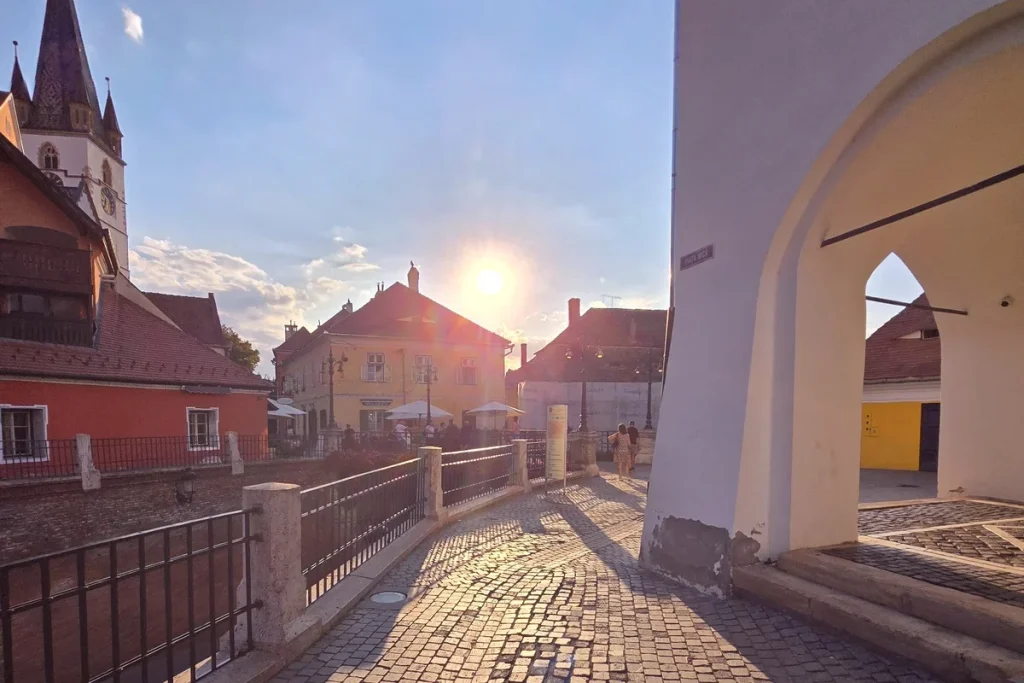
Do you need a car in Sibiu?
For the main historic-centre experience, generally no.
Sibiu has an officially regulated pedestrian zone in its historic centre, so exploring the central squares and surrounding streets is a very different planning problem from travelling around the wider region.
If your trip is mainly about the old town, museums, churches, cafés and central streets, renting a car is not a prerequisite for enjoying Sibiu.
A car becomes more relevant once you start adding places outside the centre or regional day trips.
The historic centre on foot
For many visitors, walking can cover most sightseeing inside central Sibiu.
That does not mean every traveller should treat the city as equally easy on foot.
Historic paving, slopes, passages, steps and the accumulated distance of a sightseeing day can matter if you have reduced mobility, travel with a stroller, carry heavy luggage or simply prefer to walk less.
So throughout this guide, walkable means that walking is a realistic way to move around for many visitors. It does not mean barrier-free or universally accessible.
For the broader question of what to see and how to structure a stay, use our Sibiu travel guide.
When local transport becomes useful
Local transport becomes important once your plans extend beyond the historic core.
The clearest example is the ASTRA Museum. Tursib route 13 connects Sibiu railway station with the museum, and the current timetable provides numerous departures and returns throughout the day, including weekends.
Păltiniș shows why a direct bus does not automatically mean the same level of flexibility.
Tursib route 22 also runs directly from Sibiu toward Păltiniș, but the current service pattern has only a few principal departures and returns per day.
Both journeys are direct.
They are not equally forgiving.
Who should plan more conservatively?
A car-free itinerary deserves more margin if you are travelling with young children, carrying luggage, have limited mobility or simply dislike relying on infrequent transport.
That does not automatically rule out a destination.
It changes what counts as a good plan.
A traveller who is comfortable with a long walk and one fixed return may accept a route that another traveller would reasonably reject.
The goal here is not to decide that preference for you.
It is to show you where the friction is.
What does “without a car” actually mean?
A car-free trip does not have to mean travelling exclusively by train.
Around Sibiu, a realistic journey may involve walking and a local bus, a direct intercity train, a coach or minibus, several public-transport legs, a tourist shuttle, an organized tour or a private transfer.
Those options solve different problems.
A direct train can be excellent when the station is close to what you want to see and the return timetable leaves enough flexibility.
A direct bus can still be fragile when only a few services operate each day.
A destination reached by train may become difficult if the attraction you actually want is several kilometres away.
And a tourist shuttle can sometimes create a useful car-free option where ordinary public transport does not provide one.
So in this guide:
Possible means a transport chain can be constructed.
Practical means an ordinary traveller can reasonably use that chain.
Worthwhile means the journey still leaves enough useful time at the destination to justify the effort.
The third is the one that matters most.
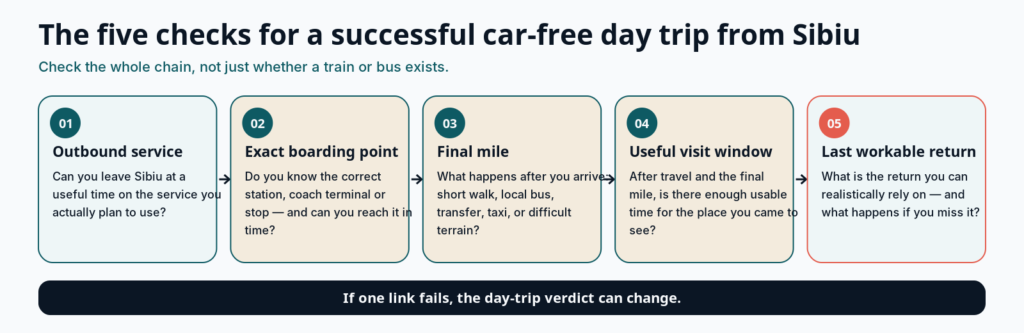
The five checks that decide whether a car-free day trip really works
Before classifying a trip from Sibiu, we check the complete journey rather than one train or bus.
1. Can you arrive at a useful time?
A service that reaches a destination late in the afternoon may technically connect Sibiu with that place.
It may still be a poor day trip.
The outbound journey needs to arrive early enough to leave meaningful sightseeing time after station exits, transfers and walking are included.
2. Do you know exactly where you board?
“Bus from Sibiu” is not precise enough.
Intercity services may use a coach terminal rather than the railway station. Local buses use specific stops. Tourist shuttles may leave from another meeting point entirely.
Before relying on a service, confirm the operator and the exact boarding location.
3. What happens after you get off?
This is the final-mile test.
A train reaching the correct town does not automatically mean it reaches the attraction you came for.
The centre may be only a short walk away. In other cases, another local service is required. Elsewhere, the remaining distance or terrain is the hardest part of the trip.
This is one of the main reasons a route planner can make a journey look easier than it is.
4. Is there enough time to make the visit worthwhile?
Transport and attraction schedules need to work together.
Arrival time, final mile, opening hours, last admission and the amount of time the place actually deserves all belong in the same calculation.
A connection is not particularly useful if it gives you several hours in the destination but very little usable time inside the attraction you travelled there to see.
5. What is the last realistic way back?
This is the check worth doing before you choose the outbound journey.
Choose the return before you fall in love with the outbound.
A morning connection can make almost any destination look attractive.
The real questions are what happens later: how many workable returns exist, what happens if one is missed, and how much of your visit has to be sacrificed to protect the final service.
A good car-free plan protects the return first and builds the sightseeing day inside that window.
Car-free day trips from Sibiu: the quick comparison
This is not another ranking of the best day trips from Sibiu.
Our separate Best Day Trips from Sibiu guide handles the broader question of which destinations are worth choosing.
Here we are asking a narrower question:
How much transport friction does each option create when you are not driving?
Easy direct
ASTRA Museum
Main car-free option: Direct Tursib bus
Main friction: Very little final-mile friction
Return risk: Low
TTT verdict: Easy direct
Mediaș
Main car-free option: Direct rail
Main friction: Short walk between station and historic centre
Return risk: Low–moderate
TTT verdict: Easy direct
Workable with careful planning
Păltiniș
Main car-free option: Direct Tursib bus
Main friction: Few daily departures
Return risk: Moderate–high
TTT verdict: Workable with careful planning
Cisnădioara
Main car-free option: Tursib network + walking
Main friction: Connection pattern + uphill final section
Return risk: Moderate
TTT verdict: Workable with careful planning
Avrig
Main car-free option: Direct rail
Main friction: What is open at the destination matters
Return risk: Moderate
TTT verdict: Workable with careful planning
Alba Iulia
Main car-free option: Direct coach + local leg/walk
Main friction: More moving parts
Return risk: Moderate
TTT verdict: Workable with careful planning
Sighișoara
Main car-free option: Direct rail / qualifying tourist service
Main friction: Useful visit window
Return risk: Schedule-dependent
TTT verdict: Workable with careful planning
Biertan
Main car-free option: Date-dependent tourist service / more complex chain
Main friction: Operating pattern + useful stop window
Return risk: High outside suitable services
TTT verdict: Workable with careful planning — strongly date-dependent
Tour or transfer usually more realistic
Corvin Castle
Main car-free option: Multi-leg journey
Main friction: Onward/final-mile complexity
Return risk: High
TTT verdict: Tour or transfer usually more realistic
Bâlea Lake
Main car-free option: Tourist transport + mountain-access step
Main friction: Season, access and weather
Return risk: High
TTT verdict: Tour or transfer usually more realistic
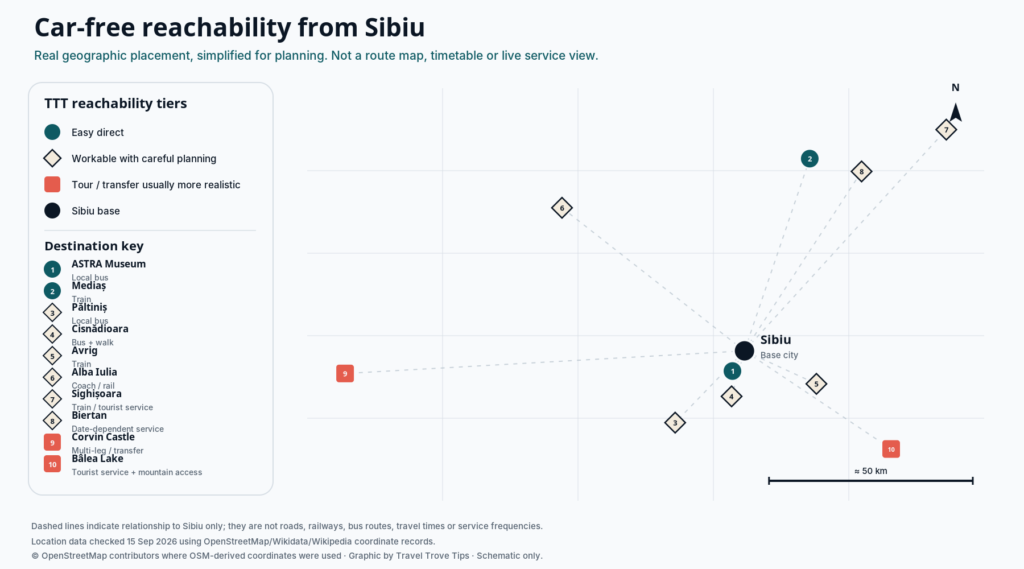
These categories describe the complete trip, not simply whether an app can find a connection.
They can change with the date.
Easy direct options
The easiest car-free outings share one useful characteristic:
the transport does not create a second trip inside the trip.
ASTRA Museum: the clearest car-free option
The ASTRA Museum is one of the strongest examples of a place outside central Sibiu that does not require a car.
Tursib route 13 links the railway station with the museum, and the present timetable offers many services throughout the day in both directions, including weekends.
That matters more than simply saying that a bus exists.
If you spend longer at the museum than expected, you usually have other return options rather than one critical departure.
The journey is therefore unusually simple:
Sibiu → direct local bus → ASTRA Museum → direct local bus → Sibiu
That is what an Easy direct option should look like.
Mediaș: why the final mile matters
Mediaș works well for another reason: arriving by rail does not leave you with a large second transport problem.
Municipal planning documents place Mediaș railway station in the vicinity of the central area and estimate the walk between the station and Piața Regele Ferdinand I at approximately 750 metres, or about nine minutes.
That is exactly the kind of final mile that strengthens a car-free day trip.
The station delivers you into a town where the main historic sightseeing area can be approached on foot rather than requiring another uncertain transfer.
You still need to check the actual trains for your date and protect a realistic return.
But structurally, Mediaș passes the car-free test well.
Workable with careful planning
These trips are not necessarily poor choices.
They simply have a weak point that deserves attention.
Păltiniș: direct does not mean flexible
Păltiniș has a major advantage: Tursib route 22 provides a direct connection from Sibiu.
The weakness is frequency.
The current timetable has only a few principal daily services in each direction.
That makes the trip structurally simple but less forgiving.
Miss a frequent local bus at ASTRA and you may have another option fairly soon.
Miss the last useful return from Păltiniș and the problem is much larger.
That is why Păltiniș belongs in Workable with careful planning despite being direct.
Frequency can matter more than the number of transfers.
Cisnădioara: the connection is possible, but it is not door-to-door
Cisnădioara shows why the final mile should never be hidden inside the phrase “you can get there by bus.”
The Tursib network links Sibiu with the ASTRA corridor and metropolitan services continuing toward the Cisnădie/Cisnădioara area. The exact connection pattern should be checked for the chosen day.
The fortified church itself is not a step-off-the-bus attraction.
It sits above the village, which leaves an uphill walking component after public transport has solved most of the journey.
That may be perfectly reasonable for one traveller and unsuitable for another.
So the honest verdict is Workable with careful planning: public transport can solve much of the trip, but the connection pattern and final climb still matter.
Avrig: the train can be easier than the visitor planning
Avrig illustrates another type of friction.
The rail corridor from Sibiu passes through Avrig, making the transport side relatively straightforward.
The more important question is what you expect to do once you arrive.
The Brukenthal estate continues to operate hospitality, garden and visitor activities, but its current information does not present every part of the property as one simple, permanent museum programme.
So Avrig does not need a complicated transport warning.
It needs a simple planning one:
check what is actually open to ordinary visitors on your date before building the day around the estate.
Alba Iulia: realistic, but with more moving parts
Alba Iulia is farther away, but current direct coach connections make the car-free case stronger than the distance may suggest.
Current services use a specific Sibiu coach terminal, which is a good example of why the exact boarding point matters.
Knowing that “a bus goes from Sibiu” is not enough.
You need to know which autogară it uses.
Once you reach Alba Iulia, you still have to solve the onward leg to the citadel and build the return into the sightseeing window.
That extra coordination keeps Alba Iulia in Workable with careful planning, even though the intercity connection itself can be reasonably strong.
Sighișoara: check the visit window, not just the train
Sighișoara is a classic example of why a direct connection and a good day trip are not identical.
The route has already been examined in detail in our dedicated Sibiu to Sighișoara and Biertan Day Trip guide.
The current UNESCO Bus Blue Line can create another option on qualifying operating days, but it is a tourist service with its own operating pattern and reservation rules.
So the useful question is not:
Is there transport to Sighișoara?
It is:
Which current connection gives me enough useful time in Sighișoara and a return I am comfortable relying on?
For the detailed comparison, use our Sibiu to Sighișoara and Biertan Day Trip guide.
Biertan: strongly date-dependent
Biertan cannot be summarized honestly with a permanent yes or no.
The UNESCO Bus Blue Line publishes different operating patterns across the year.
But seeing Biertan on a route is not enough.
The timetable has to create a usable stop, not merely pass through the village.
That is why Biertan remains Workable with careful planning — strongly date-dependent.
Check the exact pattern for your date and verify that it gives you enough time to visit before the onward or return service.
When a tour or transfer is usually more realistic
This category does not mean that a destination is impossible without renting a car.
It means that the independent chain becomes complicated enough that another car-free solution may be more sensible.
Corvin Castle: reaching Hunedoara does not finish the journey
Corvin Castle is a good example of a destination where the final approach matters as much as the intercity connection.
An independent itinerary may be possible on a particular date, but compared with Mediaș or ASTRA it involves more dependencies: reaching the Hunedoara area, solving the onward section to the castle, allowing enough time to visit and then rebuilding the chain in reverse.
That is why our general verdict is:
Tour or transfer usually more realistic.
If you attempt the journey independently, build it from the return backwards and verify every leg for your actual date.
Bâlea and the Transfăgărășan: car-free does not mean ordinary public transport
Bâlea makes the distinction especially clear.
As checked on 19 September 2026, the published Bâlea Bus service is a tourist service, not ordinary high-frequency public transport. Its listed route runs from Sibiu to Bâlea Cascadă and requires booking.
That solves one section of the problem.
It does not automatically solve the entire journey to Bâlea Lake.
Access beyond the waterfall area is a separate mountain-access question and can depend on the service, season, road, cable-car operation and weather.
So Bâlea is not simply a timetable question.
It is a transport + mountain access + season + weather question.
That is why Tour or transfer usually more realistic is the more useful category.
How to check Romanian train and bus information properly
The easiest way to make a car-free trip more reliable is to know which source should answer which question.
Google, route planners and aggregators are useful for discovering possible connections.
They should not always be the final check when your return depends on that connection.
Use the actual operator or official journey planner for rail. For coaches and minibuses, identify the named operator and confirm its own timetable or booking information where available. Local transport should be checked against the current operator timetable. Attraction planning should use the venue itself for opening days, last admission and closure information.
And for tourist shuttles, read the reservation rules carefully.
Confirm where the service actually leaves
This sounds obvious until a city has several transport departure points.
A timetable that says Sibiu → Alba Iulia does not tell a first-time visitor where in Sibiu that coach boards.
Save the exact departure point, not just the city name.
For an early or infrequent service, locate it before the morning of the trip.
Search the return separately
Never assume the outbound timetable has a convenient reverse later in the day.
Search the return as its own journey.
That is how you catch the awkward details: an early last service, different weekend operation or an outbound connection that works better than the return.
Treat old screenshots as clues, not evidence
A timetable copied into a blog, forum post or screenshot can still be useful.
It can tell you what to investigate.
It cannot prove that the same service is still operating on your travel date.
For high-consequence details — the last train, a reservation-only bus or a mountain service — reopen the current source.
Sundays, public holidays, winter and seasonal services
There is no useful universal rule saying public transport around Sibiu is “good” or “bad” on Sundays.
The answer is route-specific.
Some routes retain useful Sunday service, some operate less frequently, and some tourist services specifically include Sundays.
So the useful rule is:
check the route, not the weekday stereotype.
Winter and shoulder seasons introduce another layer.
A destination may remain physically reachable while a tourist service, attraction or mountain-access option changes its operating pattern.
Biertan is an obvious example because the UNESCO Bus uses different seasonal programmes.
Bâlea is even more sensitive because access depends not just on transport but on mountain conditions and the specific service being used.
The three TTT tiers are therefore planning categories, not permanent labels attached to a destination forever.
Plan B: what if your connection fails?
A realistic car-free itinerary needs a recovery rule before something goes wrong.
Protect the return first
If a delay threatens the last dependable connection to Sibiu, stop trying to preserve the entire original plan.
Rebuild the return first.
Drop the secondary stop
If the plan contains two places and the first one runs late, the second stop is normally the first thing to remove.
One worthwhile visit is better than two rushed stops and an uncertain journey home.
Recheck the current operator information
If a service is delayed, missed or cancelled, go back to current operator information rather than relying only on the screenshot you saved several days earlier.
Do not assume a taxi will rescue the plan
A taxi, ride-hailing car or transfer may solve a problem.
It should not be treated as a guaranteed emergency solution in an unfamiliar village or late in the day unless you have actually verified it.
If your entire return depends on an unconfirmed vehicle appearing at exactly the right moment, that is not a robust Plan B.
Be willing to change the destination
Sometimes this is the best decision.
Being car-free does not require proving that every destination is possible.
It means choosing the destinations that still make sense without driving.
Before you travel: recheck these details
Operational research for this guide was checked during construction on 15 September 2026.
The research used Tursib, CFR Călători, named coach and tourist-service operators, municipal documentation, attraction operators and other route-specific sources where appropriate.
The planning logic in this article is durable.
The schedules are not.
Before travelling, recheck the outbound service, exact boarding point, final mile, opening hours or last admission and your preferred return.
Also recheck any reservation requirement, public-holiday timetable, temporary diversion or weather-dependent mountain access that affects your route.
If your day depends on one critical final service, check that return again before leaving Sibiu.
Frequently asked questions
Do you need a car in Sibiu?
No, not for the main historic-centre experience.
The central pedestrian area is well suited to sightseeing on foot for many visitors, and local public transport extends your reach outside the old town.
A car becomes more useful when you want to combine regional destinations that have limited or fragile public-transport connections.
Is Sibiu walkable?
The historic centre is reasonably walkable for many visitors.
But walkable does not mean barrier-free. Historic paving, slopes, steps and total walking distance can matter for reduced mobility, strollers or low walking tolerance.
What are the easiest day trips from Sibiu without a car?
From the transport perspective, ASTRA Museum and Mediaș are two of the clearest low-friction examples in the current research.
That does not mean they are the “best” day trips overall.
If you are still choosing destinations, use our Best Day Trips from Sibiu guide instead.
Can you visit Sighișoara from Sibiu without a car?
Yes, but the quality of the day depends on the exact connection.
Our dedicated Sibiu to Sighișoara and Biertan Day Trip guide explains the route in more detail.
Can you visit Biertan without a car?
Yes on some dates, but it is much more timetable-dependent than ASTRA or Mediaș.
The current UNESCO Bus serves Biertan under seasonal operating programmes, with advance reservation required. The important question is whether your service creates a useful sightseeing stop, not simply whether Biertan appears on the route.
Can you visit Corvin Castle from Sibiu without a car?
An independent itinerary can be constructed in some circumstances, but it involves more pieces than the easier options in this guide.
Reaching the Hunedoara area does not by itself complete the final journey to the castle.
For many non-driving travellers, a tour or pre-arranged transfer will be the simpler solution.
Can you visit Bâlea Lake without a car?
A car-free visit can be possible, but ordinary scheduled public transport is not the whole answer.
As checked on 19 September 2026, the listed Bâlea Bus service provides tourist transport from Sibiu to Bâlea Cascadă on selected days and requires booking. Access beyond the waterfall area is a separate mountain-access question.
Do buses and trains run on Sundays?
Many do, but there is no universal answer.
Some routes retain useful Sunday service, some have limited frequency and some tourist services specifically operate on Sundays.
Check the route and the exact date.
How far in advance should I check transport?
Check early enough to decide whether the trip is worth planning, but do not make that your final verification.
Recheck ordinary transport shortly before the journey.
For reservation-only services, follow the operator’s booking deadline.
For mountain or weather-sensitive routes, perform a much fresher check close to departure.
And whenever the day depends on one critical return, verify that return again before leaving Sibiu.
Continue planning your Sibiu trip
If you are still deciding which excursion deserves a day rather than how to reach it without driving, start with our Best Day Trips from Sibiu comparison.
For the wider city and destination context, use our Sibiu travel guide.
And if Sighișoara or Biertan is already on your shortlist, use our detailed Sibiu to Sighișoara and Biertan Day Trip guide.
Browse more ideas in our Day Trips & Road Trips hub.