
By Tibi · Founder & Editor, Travel Trove Tips
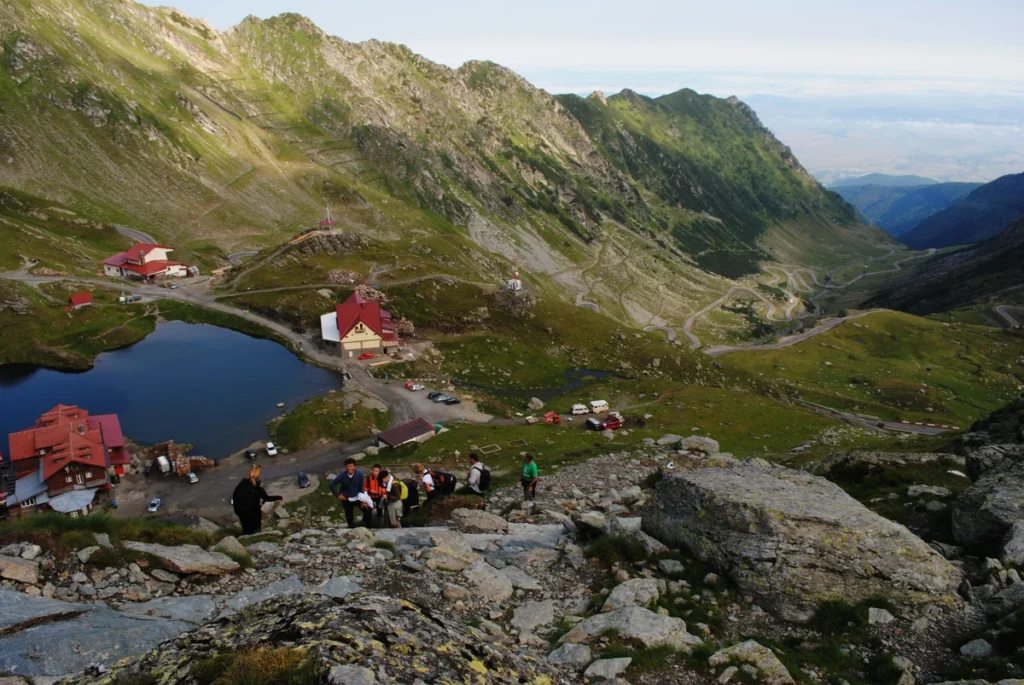

The Transfăgărășan and Bâlea Lake can make an exceptional day trip from Sibiu, but only after you define the trip you actually mean.
Driving from Sibiu to Bâlea Lake and returning the same way is not the same day as crossing the entire Transfăgărășan toward Vidraru and Curtea de Argeș. Reaching Bâlea Cascadă and taking the cable car is a third plan. Travelling without a car requires a fourth plan built around a reserved tourist transfer rather than a flexible public bus.
That distinction matters because the high road, the lower approach road, the cable car and the tourist transfer can each have a different operating state.
Quick verdict:
- With a car and the high sector confirmed open: a north-side drive from Sibiu to Bâlea Lake and back is the best default. Allow a full day and keep generous buffers for viewpoints, traffic, parking and weather.
- For the complete Transfăgărășan crossing: continue south only if you genuinely want a long driving day or are travelling onward. Returning to Sibiu after the full crossing is about 266 kilometres on the route basis used for this guide and can leave little time to enjoy the stops.
- When the high sector is closed: you may still be able to drive to Bâlea Cascadă from the Sibiu side, but reaching Bâlea Lake then depends on the cable car being confirmed operational.
- Without a car: use a currently bookable tourist transfer or tour and reconfirm it. Do not assume there is a flexible regular public bus to Bâlea Lake.
Operational information checked on 11 October 2026. Road status, cable-car operation, weather and tourist transfers can change quickly. Recheck the official sources for your date and again on the morning you travel.
First choose the trip you mean
The name “Transfăgărășan” is often used for several different experiences. Before looking at opening dates or departure times, choose which one you want.
1. Bâlea Lake from Sibiu and back
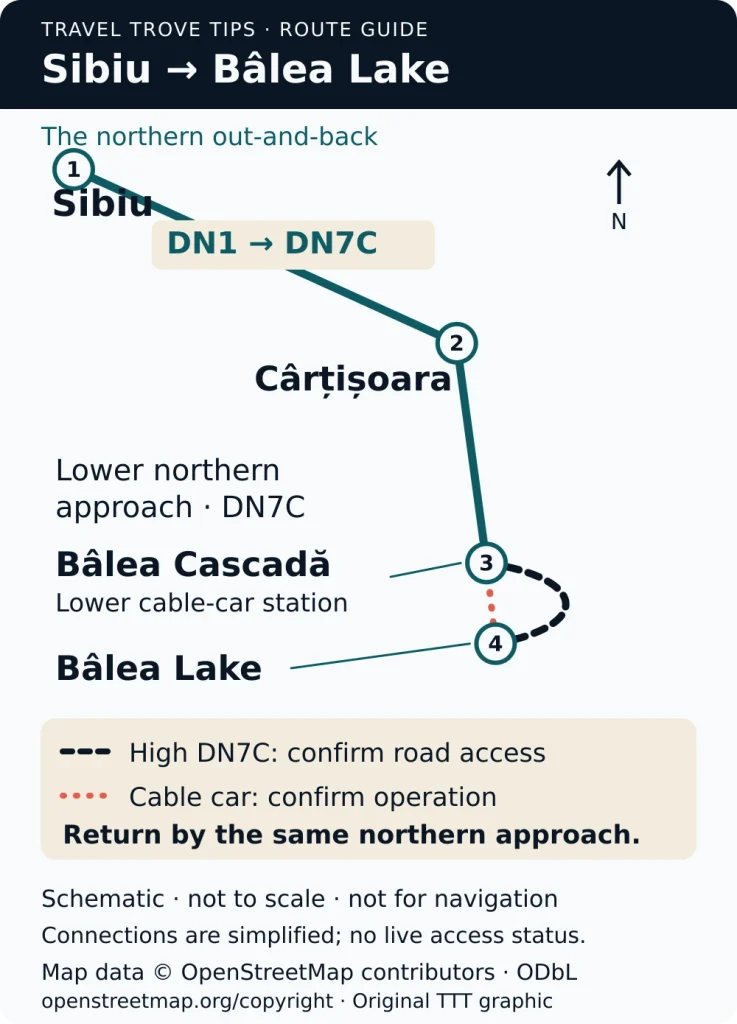
This is the clearest self-drive day. From Sibiu, follow the DN1 toward Cârțișoara, then climb the northern side of the DN7C to Bâlea Lake when the high sector is officially open.
Bâlea Lake is roughly 77 kilometres from Sibiu on the route basis used for this guide. The return drive uses the same northern approach, so the road distance is about 154 kilometres before any detours.
This version protects time for the best-known northern hairpins, viewpoints and Bâlea Lake without forcing the long southern descent into the same day.
2. The complete Transfăgărășan crossing
This means continuing through the tunnel and descending south toward Vidraru and Curtea de Argeș.
It is a real crossing, not a short extension beyond the lake. Bâlea Lake to Curtea de Argeș is roughly another 78 kilometres of mountain and valley road. If you then return to Sibiu by the lower route, the complete loop is about 266 kilometres on the same route basis.
Choose this version if the road itself is your main activity, if you accept a very long day, or if Curtea de Argeș is your next overnight base. It is not the most relaxed default for a visitor who must return to Sibiu.
3. Bâlea Cascadă plus the cable car
When the high sector is closed, the northern lower road may still allow access to Bâlea Cascadă and the lower cable-car station.
This does not automatically mean Bâlea Lake is reachable. The cable car is a separate transport system affected by weather, technical conditions, passenger rules and its own programme. Confirm both the road to the lower station and the cable car before leaving Sibiu.
4. A reserved transfer or organized trip
This is normally the more realistic no-car option. It reduces the final-mile problem but does not remove weather, traffic or cable-car risk.
The Bâlea Bus information currently published through Sibiu’s tourism platform describes a reservation-only tourist service rather than a regular public timetable. Its conditions allow timetable changes or cancellation and warn that traffic can create major delays.
Choose the access plan that matches today’s conditions
The options below are planning cards, not a live status board. Always use the official road, operator and weather sources to identify the current state.
Lake out-and-back
Road: high sector positively confirmed open.
Cable car: not required.
Mode: self-drive.
Recommendation: Bâlea Lake north-side out-and-back.
Fallback: turn back early if traffic or weather consumes the buffer.
Complete crossing
Road: high sector positively confirmed open.
Cable car: not required.
Mode: self-drive with a road-focused day or onward route.
Recommendation: complete crossing only when the long drive is intentional or the next overnight base is south of the mountains.
Fallback: Bâlea Lake out-and-back.
Closed high road, cable car confirmed
Road: high sector closed; lower northern approach confirmed open.
Cable car: confirmed operating.
Mode: car or reserved transfer.
Recommendation: Bâlea Cascadă plus cable car.
Fallback: Cârța and the Făgăraș foothills.
Closed high road, cable car unresolved
Road: high sector closed; lower northern approach confirmed open.
Cable car: unconfirmed or suspended.
Mode: car or reserved transfer.
Recommendation: do not promise Bâlea Lake.
Fallback: Bâlea Cascadă direction or lower-altitude Plan B.
Evidence unresolved
Road: current access evidence unresolved.
Cable car: any state.
Mode: any.
Recommendation: do not start an alpine-dependent plan.
Fallback: lower-altitude Plan B.
Severe weather or official restriction
Road: restricted or unsafe for the planned route.
Cable car: any state.
Mode: any.
Recommendation: cancel or change the mountain day.
Fallback: choose a stable cultural day trip.
A realistic self-drive day from Sibiu
For most visitors, the best version is the northern Bâlea Lake out-and-back.
A conservative shape is:
- Leave Sibiu early.
- Use the DN1 to reach the Cârțișoara turn-off.
- Continue up the northern DN7C, stopping selectively rather than at every pull-off.
- Reach Bâlea Lake with enough time for a real visit.
- Start the descent while you still have a comfortable daylight, weather and traffic buffer.
- Return to Sibiu on the same northern route.
Do not convert this into a minute-perfect itinerary. Use these planning cards instead:
Outbound drive
Allow 1 hour 40 minutes to 2 hours in normal conditions. On a busy or slow day, it can take 2 hours 30 minutes or more.
Viewpoint and roadside stops
Allow 30–60 minutes in a restrained plan, or 60–90 minutes when the road is busy or you make more stops.
Parking and approach
Allow 15–30 minutes normally and 30–60 minutes in peak conditions.
Useful time at Bâlea Lake
Protect at least 1 hour 30 minutes. A more comfortable visit can use up to 3 hours.
Return drive
Allow 1 hour 40 minutes to 2 hours in normal conditions, with 2 hours 30 minutes or more possible on a slow day.
Final buffer
Keep 30–60 minutes protected in a normal plan and 60–90 minutes in peak conditions.
This produces roughly a seven-to-ten-hour day, with longer outcomes possible on busy weekends or when weather slows the road.
The ranges are editorial planning estimates, not live-navigation promises. Check current navigation shortly before departure and avoid stopping where it is illegal or unsafe.
Should you cross the whole Transfăgărășan?
Crossing the road can be worthwhile, but it solves a different travel job.
Continue south if:
- the high sector is officially confirmed open;
- you want the road itself to dominate the day;
- every driver is comfortable with prolonged mountain driving;
- you have enough daylight and weather margin;
- you are staying near Curtea de Argeș, Pitești or Bucharest afterwards; or
- you knowingly accept a long return to Sibiu.
Turn back from Bâlea Lake if:
- you want meaningful time at the lake and viewpoints;
- you are travelling with children, older passengers or someone prone to motion sickness;
- traffic has already consumed your buffer;
- the weather is deteriorating; or
- Sibiu remains your base that night.
For a return to Sibiu, the complete crossing can require six to seven hours of pure driving before scenic stops, food, parking and time at the lake. That can push the real day toward ten to twelve hours.
Check restrictions and diversions on the lower return route to Sibiu as well; an open alpine sector does not guarantee a clear route home.
The honest question is not “Can the loop be driven?” It is “Will enough of the day remain to enjoy why you chose it?”
When the high road is closed
The seasonal closure normally concerns the alpine sector between Bâlea Cascadă and Piscu Negru. It does not mean every kilometre of the DN7C is inaccessible.
From the Sibiu side, the lower road can still lead toward Cârțișoara and Bâlea Cascadă, subject to current conditions and restrictions. Bâlea Lake may then be reachable by cable car, but only if the operator confirms that it is running.
Do not rely on a generic “open” badge. Look for the exact road sector and the exact transport link:
- Is the lower road to Bâlea Cascadă open?
- Is the alpine DN7C sector open to cars?
- Is the cable car operating?
- What is the last safe descent for a day visitor?
- Does your return transport wait if the cable car stops?
If any critical link is unresolved, use the lower-altitude Plan B rather than building the day around hope.
Using the Bâlea cable car
The cable car connects Bâlea Cascadă with Bâlea Lake, but it is not a guaranteed replacement for the closed road.
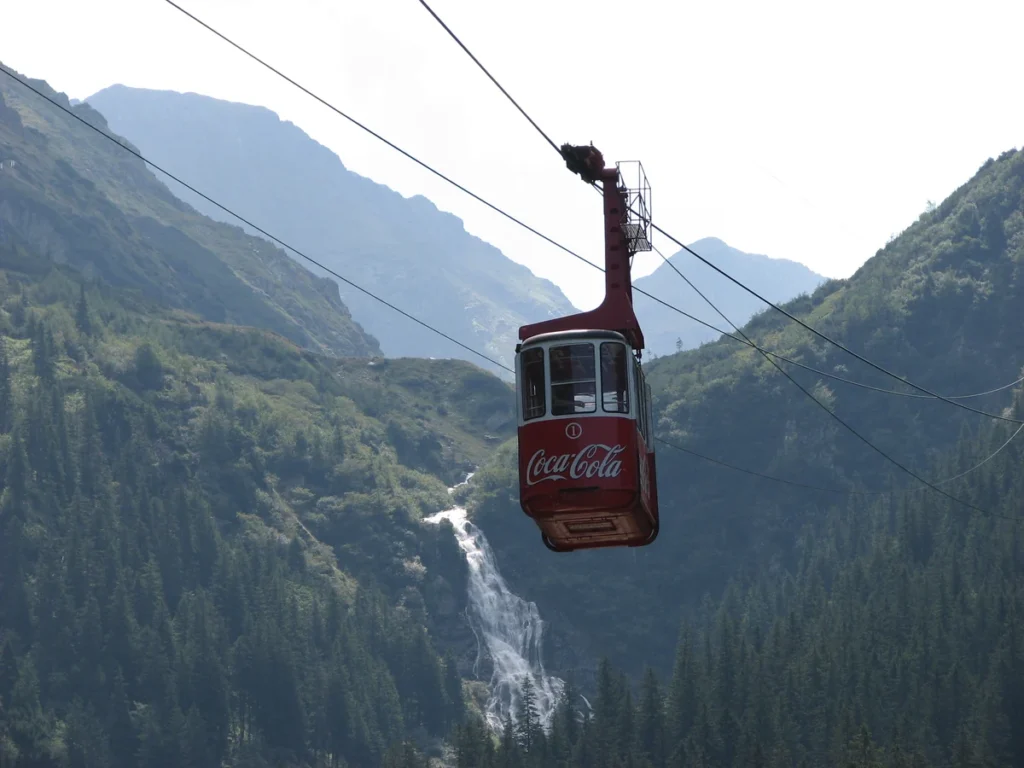

The operator currently states that departures require a minimum number of passengers, accommodated guests may receive priority and operation can be suspended in poor weather. Those points matter more than an attractive headline timetable.
The operator’s website currently displays conflicting hours, fares and journey durations on the same page. For that reason, this guide does not reproduce a price or promise an exact last descent. Check the operator’s current page and confirm the workable return before travelling.
Build in time for:
- parking or arrival at the lower station;
- ticket purchase;
- waiting for enough passengers;
- boarding;
- weather-related interruption;
- the final descent; and
- your onward road or transfer back to Sibiu.
If your day depends on a specific descent, do not plan around the advertised closing time alone. The last practical boarding may be earlier.
Visiting without a car
There is no simple independent public-transport chain that offers the same flexibility as driving.
The practical option is a confirmed tourist transfer or organized tour. The currently published Bâlea Bus information describes:
- departure from the Sala Thalia parking area in Sibiu;
- advance online reservation;
- limited operating days and times;
- separate seasonal programmes for Bâlea Cascadă and Bâlea Lake;
- the possibility of delays, timetable changes or cancellation; and
- a specific risk if the cable car stops operating.
Treat this as a reservation-only tourist service, not a city bus. The published listing does not confirm availability for your date; check that the booking system works and that your outward and return journeys are confirmed before arranging the rest of your day.
The most important no-car questions are:
- Is your date available in the booking system?
- Does the service go to Bâlea Cascadă or to Bâlea Lake on that date?
- Is the cable-car ticket included or separate?
- What happens if the cable car stops?
- Which return is protected, and how much buffer do you have?
- Is there a refund or alternative if the operator cancels?
For the full method, see Sibiu Without a Car: How to Get Around and Take Realistic Day Trips.
Parking, traffic and roadside stops
The northern climb is part of the attraction, which is exactly why summer traffic can become part of the problem.
Allow more time on weekends and during good-weather holiday periods. Parking availability, roadside controls and safe stopping points can change, so use current signs and instructions rather than an old travel photo.
Do not:
- stop on a blind bend;
- block the carriageway for a photograph;
- assume a line of parked cars makes a location legal or safe;
- feed or approach wildlife; or
- continue beyond a closure sign because another vehicle did so.
A photograph is never worth removing the safety buffer that protects the rest of the day.
Weather, altitude and wildlife
Bâlea Lake sits above 2,000 metres. Conditions can be very different from Sibiu, even on the same day.
Before departure, check:
- the official mountain forecast and active warnings;
- wind and visibility, especially if you need the cable car;
- temperature and precipitation at altitude rather than only in Sibiu;
- current road restrictions; and
- operator notices.
Carry a warm and weather-resistant layer even when Sibiu is comfortable. If you plan to leave the immediate visitor area for a marked mountain route, use proper hiking information and equipment; this article is not a hiking or winter-mountaineering guide.
Brown bears are sometimes seen near the Transfăgărășan. Keep your distance, remain inside the vehicle when appropriate, never feed an animal and never frame a roadside bear as a photo opportunity. Feeding wild bears changes their behaviour and increases danger for both people and animals.
Who should modify the plan?
Families with children
Choose the Bâlea Lake out-and-back and reduce the number of roadside stops. Protect food, toilet, warm-clothing and return buffers. Do not promise that a long queue or cable-car wait will be easy for every child.
Older visitors or people with limited mobility
Do not infer accessibility from a short map distance. Parking position, uneven ground, crowds, stairs and cable-car boarding can change the real burden. Keep the visit close to the main Bâlea Lake area unless current, specific accessibility information supports more.
Motion-sensitive passengers
The repeated bends are part of the road’s character. The full crossing adds many more kilometres of winding road. The north-side out-and-back is easier to shorten if a passenger becomes uncomfortable.
Visitors with little tolerance for uncertainty
Choose a lower-altitude cultural day or another published Sibiu day trip. The Transfăgărășan is the least stable of the main Sibiu options because several independent systems must align.
Plan B: Cârța and the Făgăraș foothills
If the alpine plan fails, keep the day geographically coherent instead of driving to the other side of Transylvania.
A practical lower-altitude alternative can include:
- Cârța and the former Cistercian abbey, after checking current visitor access;
- Cârțișoara and the northern approach landscape;
- one confirmed foothill stop; and
- a relaxed return to Sibiu.
This is not a substitute for alpine scenery, but it can still become a worthwhile cultural and landscape day. Verify each small site’s opening information before relying on it.
If mountain weather is the only problem and you still want a different day trip, compare the options in Best Day Trips from Sibiu. For a more stable long road day, Corvin Castle and Alba Iulia is less dependent on alpine access, although attraction hours still require checking.
What to check before leaving Sibiu
Use this order:
- Road sector: look for a positive, named-sector update from CNAIR or Romanian Police INFOTRAFIC.
- Weather: check the official mountain forecast and active warnings.
- Cable car: confirm operation, programme and the practical last descent on the operator’s current page.
- Transport: if you are not driving, confirm your reservation and return conditions.
- Navigation: check current traffic and route disruption shortly before departure.
- Fallback: decide in advance what will make you turn back or switch to Plan B.
Do not use the date on which the road opened for the season as proof that it is open today.
Frequently asked questions
Is the Transfăgărășan open all year?
No. The alpine sector between Bâlea Cascadă and Piscu Negru closes seasonally and can also close temporarily after reopening because of weather or safety conditions. Lower sections can remain accessible when the high crossing is closed.
When did the high road open in 2026?
The sector between Bâlea Cascadă and Piscu Negru reopened on 12 June 2026, with a published daily traffic window of 07:00–21:00 and the possibility of temporary weather closures. This is dated 2026 context, not proof of current or future access.
Can I drive from Sibiu to Bâlea Lake and back in one day?
Yes, when the high sector is confirmed open. It is the most realistic self-drive version from Sibiu. Allow a full day rather than treating the lake as a quick turnaround point.
Can I cross the entire Transfăgărășan and return to Sibiu?
It is physically possible when the road is open, but it creates a very long driving day. It makes more sense when the road itself is your main activity or when you continue to an overnight base south of the mountains.
Can I reach Bâlea Lake when the road is closed?
Potentially. You may be able to drive or take a transfer to Bâlea Cascadă and use the cable car. Confirm the lower road and cable car separately; neither proves the other is operating.
Does the cable car run every day?
Do not assume it does. Weather, technical conditions, passenger rules and operator decisions can interrupt service. Check the exact day and protect the descent.
Can I visit Bâlea Lake without a car?
Yes, most realistically through a reserved tourist transfer or organized tour. It is not the same as having a frequent, flexible public bus, and you must verify the return chain.
How long should I spend at Bâlea Lake?
Protect at least 90 minutes for a basic visit after parking, queues or cable-car travel. Allow more if you want a meal or a properly researched walk. Do not begin an unplanned mountain hike because extra time appears in the schedule.
Is this day suitable for young children or older visitors?
It can be, especially as the shorter northern out-and-back, but the winding road, altitude, weather, parking position, crowds and waiting can increase the burden. Shorten the plan and keep larger buffers.
Final recommendation
For most travellers based in Sibiu, choose the Bâlea Lake out-and-back when the high road is officially confirmed open. It gives you the most recognisable northern scenery and enough time at the lake without turning the whole day into a return drive from Curtea de Argeș.
Choose the complete crossing when you are travelling onward or deliberately want a long road-focused day.
Choose Bâlea Cascadă plus the cable car only after both links are confirmed.
Without a car, use a reserved and reconfirmed tourist transfer or tour, not an assumed regular bus.
The right plan is not the one that covers the most kilometres. It is the one whose road, weather, transport and return conditions still leave enough time to experience the mountain.